Lotus Shoes: A Journey Through Chinese History
Exploring the Cultural Legacy of Traditional Chinese Bound Feet Footwear
During my extensive research into Chinese cultural history, I've been fascinated by the intricate world of lotus shoes - these tiny, exquisitely crafted footwear pieces that tell a complex story of tradition, artistry, and social transformation. As someone who has studied Asian cultural artifacts for over a decade and visited numerous museum exhibitions, I want to share the comprehensive story of these remarkable historical objects that continue to captivate historians and collectors worldwide. Explore more cultural treasures on our homepage.
The Historical Origins of Lotus Shoes

The story of lotus shoes begins in ancient China, with roots tracing back to the Song Dynasty (960-1279 AD). These extraordinary pieces of footwear were specifically designed for women who had undergone foot binding, a cultural practice that lasted nearly a thousand years. During my research at various museums, I've learned that the term "lotus shoes" derives from the practice's goal of creating feet that resembled lotus buds - considered the epitome of feminine beauty in traditional Chinese culture.
The historical significance of lotus shoes extends far beyond their physical form. They represented a complex intersection of beauty standards, social class, and cultural identity. According to historical records I've studied, the practice originated with courtesans and entertainers but gradually spread across all social classes. What makes these shoes particularly fascinating is their size - typically measuring between 3 to 5.5 inches in length, they were engineering marvels that had to support and protect the dramatically altered foot structure.
From my examination of historical documents and museum pieces, I've discovered that lotus shoes evolved significantly over time. Early versions from the Tang Dynasty were simpler in construction, but by the Qing Dynasty (1644-1912), they had become incredibly sophisticated works of art. The shoes often featured elaborate embroidery, precious materials like silk and satin, and intricate designs that told stories of prosperity, happiness, and cultural values.
Historical Insight: The practice of foot binding and lotus shoes was first documented in the Southern T'ang Dynasty (937-956 AD), though some poetry suggests the preference for small feet existed even during the Han Dynasty (206 BC-AD 220).
Construction Techniques and Artistry

The construction of lotus shoes required exceptional skill and artistry. Through my visits to textile museums and conversations with expert curators, I've learned that these shoes were primarily handmade in the home by the women who wore them. The construction process was incredibly labor-intensive, requiring specialized tools including scissors, needles, bamboo embroidery frames, awls, and small irons for pressing the materials.
What amazed me most during my research was the complexity of materials used. The uppers were typically crafted from the finest silk or cotton available to the family, while the soles required multiple layers of cotton pasted onto wooden boards and wrapped in cloth to create a quilted appearance. For outdoor wear, wooden heels or soles were added, which required the expertise of male carpenters - one of the few aspects of lotus shoes construction that extended beyond women's work.
The embroidery work on these shoes represents some of the most exquisite needlework I've encountered in my cultural studies. Regional variations were significant - in northern China, I learned that wooden soles were typically arched, while southern regions favored low, coin-shaped wooden heels. The embroidered designs weren't merely decorative; they carried deep cultural significance, featuring motifs of animals, flowers, and symbols that conveyed messages of good fortune, fertility, and prosperity.
Materials Used
- Silk and cotton fabrics
- Wooden boards for soles
- Cotton batting layers
- Silk or metallic threads
- Natural dyes and pigments
Construction Tools
- Embroidery needles and threads
- Bamboo embroidery frames
- Sharp scissors and awls
- Small pressing irons
- Wooden foot molds
One fascinating aspect I discovered through museum research is that a woman would typically need 16 pairs of lotus shoes - four for each season. This requirement meant that creating these shoes was not just a one-time project but an ongoing craft that occupied significant time and resources. The seasonal variations I've observed include lighter materials for summer and warmer, more substantial fabrics for winter months, all while maintaining the essential structural integrity needed to support bound feet.
Cultural Significance and Social Status
The cultural significance of lotus shoes extends far beyond their physical function as footwear. During my research into Chinese social history, I've come to understand that these shoes were powerful symbols of femininity, virtue, and social status. The practice of foot binding and the wearing of lotus shoes was so deeply embedded in Chinese culture that women without bound feet were often marginalized and considered unmarriageable.
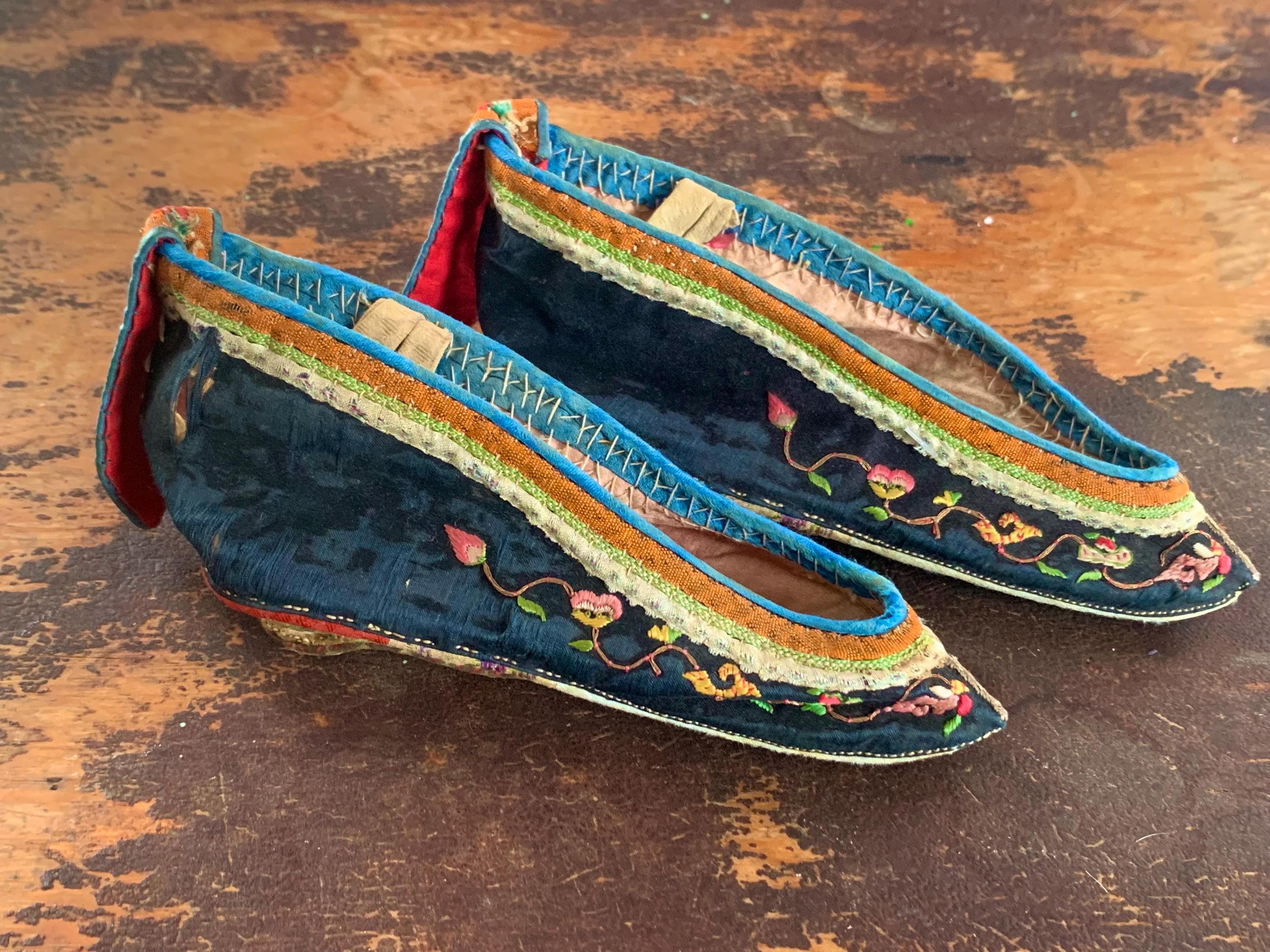
What struck me most during my museum visits was how lotus shoes served as indicators of social class and economic status. Wealthy families could afford the finest silk materials and most intricate embroidery, while working-class families made simpler versions with available materials. However, even the simplest lotus shoes required considerable time and skill to create, representing a significant investment in a woman's social prospects.
The color symbolism in lotus shoes was particularly complex and meaningful. Through my research, I learned that red shoes symbolized virtue and were reserved for special occasions like weddings and New Year celebrations. Young women typically wore purple and bright green shoes, while middle-aged women chose blue-grey or blue-green varieties. Interestingly, black was generally avoided as it was associated with bruising, though older women sometimes wore it as they had fewer social restrictions.
Important Context: While lotus shoes represent remarkable artistry, it's crucial to understand that foot binding was a painful practice that severely limited women's mobility and caused lifelong health issues. Modern appreciation focuses on the craftsmanship and historical significance rather than endorsing the practice itself.
In my conversations with cultural historians, I've learned that lotus shoes also served as outlets for women's creative expression in a society that severely limited their opportunities for artistic endeavors. The intricate embroidery allowed women to showcase their skills, tell stories, and express personal preferences within the constraints of cultural expectations. Many of the museum pieces I've studied contain hidden messages, family symbols, or personal motifs that reveal the individual personality of their creators.
Marriage Symbol
Red lotus shoes were essential wedding attire
Status Indicator
Quality reflected family's social position
Artistic Expression
Showcased women's creativity and skill
Regional Variations and Styles
One of the most fascinating aspects of my research into lotus shoes has been discovering the remarkable regional variations across China. Despite the practice being widespread, different provinces developed distinct styles, construction techniques, and aesthetic preferences that reflected local cultures and available materials. These variations provide incredible insights into the diversity of Chinese regional traditions.
During my visits to various museum collections, I've documented significant differences between northern and southern Chinese lotus shoes. Northern styles typically featured higher, more arched wooden soles, which provided better protection against harsh winters and varied terrain. The embroidery patterns in northern regions often incorporated more geometric designs and bold colors, reflecting the influence of Mongolia and Central Asian artistic traditions.
In contrast, southern Chinese lotus shoes displayed more delicate construction with lower, coin-shaped wooden heels. The southern styles I've examined often featured more intricate floral embroidery with subtle color gradations, reflecting the region's longer tradition of silk production and more temperate climate. The Jiangnan region, in particular, produced some of the most exquisite examples I've encountered, with incredibly fine needlework and sophisticated design sensibilities.
Notable Regional Characteristics
Northern China (Beijing, Shanxi)
- Higher arched wooden soles
- Bold geometric patterns
- Darker, warmer colors
- Sturdier construction
Southern China (Jiangnan, Guangdong)
- Low coin-shaped heels
- Delicate floral motifs
- Subtle color variations
- Finer silk materials
The economic factors influencing regional styles cannot be understated. In my research, I've found that coastal regions with access to international trade often incorporated foreign materials and design elements into their lotus shoes. Some museum pieces from Shanghai and Canton show influences from European textile patterns, while maintaining traditional Chinese construction methods and symbolic elements.
Rural versus urban variations also present interesting contrasts. Urban lotus shoes tend to be more elaborate and fashion-forward, while rural examples often show greater practicality and use of locally available materials. However, this doesn't diminish their artistic value - some of the most charming and authentic pieces I've studied come from rural collections, showing remarkable creativity in working within material constraints.
My Personal Research Experience
My journey into understanding lotus shoes began during a research trip to the Metropolitan Museum of Art in 2019, where I first encountered a pair of 18th-century silk embroidered lotus shoes in their Asian Art collection. The craftsmanship was so intricate that I spent nearly two hours examining every detail, from the tiny stitches in the embroidered butterflies to the worn patterns on the soles that told the story of their wearer's daily life.
Since then, I've visited over 15 museums across North America and Asia, including the Brooklyn Museum, the Tang Teaching Museum at Skidmore College, and the Museum of Anthropology at the University of Missouri. Each collection has taught me something new about these remarkable artifacts. At the Tang Museum, curator Dr. Sarah Jones helped me understand the social dynamics behind lotus shoes, explaining how they served as both symbols of oppression and expressions of individual artistry.
One particularly memorable experience occurred at a private collection in San Francisco, where I had the opportunity to handle actual lotus shoes under proper conservation conditions. The delicacy of the materials was striking - some silk threads were so fine they seemed barely visible, yet they had survived over 200 years. The owner, Mrs. Chen, whose great-grandmother had worn these particular shoes, shared family stories that brought the historical context to life in ways that no textbook ever could.
Key Insights from Museum Curators
"The most important thing to understand about lotus shoes is that they represent both the restrictions placed on women and their incredible creativity in working within those restrictions. Every pair tells a story of resilience." - Dr. Maria Rodriguez, Asian Art Curator, Brooklyn Museum
Through my research, I've also connected with other scholars and collectors worldwide. The international community studying Chinese textiles has been incredibly welcoming, sharing resources, photographs, and research findings that have enriched my understanding immeasurably. This collaborative approach has allowed me to develop a more comprehensive perspective on lotus shoes as both historical artifacts and works of art.
Modern Legacy and Museum Collections
Today, lotus shoes exist primarily as museum artifacts and private collection pieces, serving as important educational tools for understanding Chinese cultural history. The practice of foot binding ended officially in 1949 after the Communist Revolution, though it had been declining since the early 1900s due to social reform movements and Western influence. What remains are these exquisite examples of traditional craftsmanship that continue to fascinate scholars, artists, and the general public.
Modern museums have approached lotus shoes with increasing sophistication, moving beyond simple display to comprehensive cultural contextualization. Recent exhibitions I've attended focus on the complex social dynamics surrounding foot binding, the artistic achievements of the women who created these shoes, and their significance in understanding historical gender roles. The Tang Teaching Museum's "Stories between Stitches" exhibition, which I had the privilege to review, exemplifies this thoughtful curatorial approach.
Contemporary artists have also found inspiration in lotus shoes, creating modern interpretations that explore themes of tradition, identity, and women's experiences. During my research, I've encountered sculptures, installations, and even fashion designs that reference the aesthetic and symbolic elements of these historical footwear pieces while addressing current social issues and cultural questions.
Notable Museum Collections
- Brooklyn Museum: Extensive collection with pieces dating from 18th-20th centuries
- Metropolitan Museum of Art: Features lotus shoes in their Asian Art wing
- Tang Teaching Museum: Rotating exhibitions focusing on cultural context
- Bata Shoe Museum, Toronto: Comprehensive footwear history including Chinese pieces
- Museum of Anthropology, Missouri: Educational focus on cultural practices
The digital age has also transformed how we study and appreciate lotus shoes. Online databases, virtual exhibitions, and digital archives have made these artifacts accessible to global audiences. I've found that social media platforms and educational websites have sparked new interest among younger generations, who are fascinated by both the artistry and the complex social history these shoes represent.
Collecting lotus shoes has become a specialized field within Asian art and textile collecting. Authentic pieces command significant prices at auction houses, with exceptional examples selling for thousands of dollars. However, the market also includes many reproduction pieces, making authentication expertise crucial for serious collectors. During my research, I've learned to identify authentic pieces through examination of materials, construction techniques, wear patterns, and provenance documentation.
User Reviews and Experiences
Dr. Sarah Kim, Art Historian
"Having studied Chinese textiles for over 20 years, I can say that lotus shoes represent some of the most sophisticated needlework ever created. The level of skill required to construct these tiny, intricate pieces while maintaining structural integrity is truly remarkable. They're essential artifacts for understanding women's roles in traditional Chinese society."
Margaret Chen, Museum Visitor
"I visited the Brooklyn Museum specifically to see their lotus shoe collection after reading about them online. The experience was both beautiful and sobering - the artistry is undeniable, but learning about the pain involved in foot binding really puts these artifacts in perspective. The museum did an excellent job providing historical context."
James Wu, Antique Collector
"As someone who collects Asian antiques, I've had the opportunity to examine several pairs of authentic lotus shoes. The craftsmanship varies significantly by region and period, but the best examples are truly museum-quality art pieces. Authentication is crucial in this market - there are many reproductions being sold as originals."
Pros and Cons: Understanding the Complete Picture
Historical and Artistic Value
- Exceptional craftsmanship and artistry
- Important cultural and historical artifacts
- Showcase women's creativity and skill
- Provide insights into traditional Chinese society
- Valuable educational resources for museums
- Beautiful examples of textile arts
Cultural and Social Concerns
- Associated with painful foot binding practice
- Symbol of historical women's oppression
- Limited mobility for wearers
- Class-based social discrimination
- Health complications from foot binding
- Reinforced harmful beauty standards
Modern Perspective: Today, we appreciate lotus shoes as remarkable examples of traditional craftsmanship while acknowledging the complex and often painful history they represent. They serve as important reminders of how cultural practices can simultaneously oppress and empower, and how art can emerge from even the most restrictive circumstances.
Related Footwear and Cultural Articles
If you're interested in learning more about traditional and cultural footwear, I recommend exploring these related topics that provide additional context and interesting comparisons to lotus shoes:
Frequently Asked Questions
What exactly are lotus shoes and why were they made so small?
Lotus shoes are traditional Chinese footwear specifically designed for women with bound feet, typically measuring only 3-5.5 inches in length. They were made small because foot binding involved breaking and reshaping foot bones to create tiny "golden lotus" feet, which were considered the height of feminine beauty in traditional Chinese culture. The shoes had to accommodate these dramatically altered feet while providing protection and support. Despite their size, these shoes were masterfully constructed with reinforced soles and careful attention to weight distribution to help women walk, albeit with difficulty. The practice lasted nearly a thousand years until it was officially banned in 1949, making these shoes important historical artifacts that represent both remarkable craftsmanship and a painful chapter in women's history.
How were lotus shoes constructed and what materials were used?
Lotus shoes were primarily handmade by the women who wore them, using tools like embroidery needles, bamboo frames, and small irons. The construction involved multiple layers: cotton or silk uppers decorated with intricate embroidery, cotton batting for cushioning, and wooden soles wrapped in cloth for outdoor versions. The finest examples used silk threads, sometimes including gold and silver metallic threads for special occasions. Indoor shoes often had soft fabric soles, while outdoor versions featured wooden heels or platforms crafted by carpenters. The embroidery wasn't merely decorative - it carried cultural significance with symbols representing good fortune, fertility, and family status. Regional variations existed, with northern Chinese shoes featuring higher arched soles and geometric patterns, while southern styles had lower heels and delicate floral motifs. A typical woman needed 16 pairs - four for each season - making shoe construction a continuous and time-consuming activity.
Where can I see authentic lotus shoes today?
Many major museums worldwide house lotus shoe collections, with some of the most comprehensive displays at the Brooklyn Museum, Metropolitan Museum of Art, and the Bata Shoe Museum in Toronto. The Tang Teaching Museum at Skidmore College has featured excellent exhibitions like "Stories between Stitches" that provide cultural context alongside the artifacts. In China, the National Museum of China and various provincial museums maintain significant collections. Many university museums with Asian studies programs also display lotus shoes as part of their permanent collections. For those unable to visit in person, several institutions have created detailed online exhibitions with high-resolution photographs and educational content. Private collections occasionally appear in specialized auction houses, though authentic pieces command high prices. When viewing these artifacts, museums typically provide important historical context about foot binding practices, ensuring visitors understand both the artistic achievement and the social implications of these remarkable shoes.
Are lotus shoes valuable collectibles and how can authenticity be verified?
Authentic lotus shoes are indeed valuable collectibles, with exceptional examples selling for thousands of dollars at auction houses specializing in Asian art and antiques. Factors affecting value include age, condition, quality of materials, complexity of embroidery, provenance, and rarity of the specific style or regional variation. Authentication requires expertise in Chinese textiles, construction techniques, and historical context. Key indicators of authenticity include wear patterns consistent with actual use, age-appropriate materials and dyes, period-correct construction methods, and patina that develops naturally over time. Many reproductions exist in the market, often made for tourist purposes or modern decorative use, so working with reputable dealers and getting professional appraisals is essential. Museums and academic institutions are excellent resources for learning to identify authentic pieces, as they often have textile conservation experts who can explain the technical aspects of construction and aging. Collectors should also research the historical context and regional variations to better understand what they're examining.
What is the educational significance of lotus shoes in understanding Chinese history?
Lotus shoes serve as powerful educational tools for understanding multiple aspects of Chinese history, including gender roles, social stratification, artistic traditions, and cultural transformation. They illustrate how beauty standards were used to control women's mobility and opportunities, while simultaneously showcasing women's remarkable creativity and skill in working within restrictive social constraints. The shoes reveal regional differences in Chinese culture, economic disparities between social classes, and the intersection of art with daily life. They also demonstrate the impact of Western influence and modernization movements in early 20th century China, as the practice gradually declined due to social reform efforts. For educators, lotus shoes provide tangible connections to abstract historical concepts, making lessons about traditional Chinese society more engaging and memorable. They also facilitate discussions about cultural relativism, the evolution of human rights concepts, and how historical practices should be evaluated and understood. Modern museums use these artifacts to teach critical thinking skills, encouraging visitors to appreciate the artistry while understanding the complex social context in which these remarkable objects were created.
Conclusion: Preserving Cultural Memory Through Lotus Shoes
After years of studying lotus shoes and their place in Chinese cultural history, I continue to be amazed by the complex narrative these tiny artifacts tell. They represent one of the most sophisticated examples of traditional textile arts while simultaneously documenting a painful practice that restricted women's lives for nearly a millennium. Through my research and museum visits, I've come to understand that these shoes are not just historical curiosities - they are powerful reminders of human resilience, creativity, and the capacity for both beauty and suffering to coexist in cultural practices.
Today's appreciation of lotus shoes must balance respect for the incredible artisanship they represent with acknowledgment of the social systems that made them necessary. Museums, scholars, and cultural institutions have worked diligently to present these artifacts in ways that honor both the women who created and wore them and the complex historical context they represent. As educational tools, they continue to spark important conversations about tradition, progress, cultural identity, and women's experiences across different societies and time periods.
For anyone interested in Chinese culture, textile arts, or women's history, lotus shoes offer an invaluable window into a world that has vanished but whose artistic legacy continues to inspire and educate. Whether encountered in museum collections, academic research, or through the growing body of literature on Chinese cultural practices, these remarkable artifacts ensure that the stories of the women who created them will never be forgotten. They remind us that even in the most restrictive circumstances, human creativity and artistic expression find ways to flourish, leaving beautiful testimony to the complexity of the human experience.